
Last updated
Free tool · no signup
HOA chart of accounts
A ready-made chart of accounts for a self-managed HOA, organised for an operating fund and a reserve fund. Answer a few questions to trim it to your association, then download it as CSV, Excel or PDF.
Build your chart of accounts
Tick what applies. The list below updates as you go.
| No. | Account | Type | Usually used by | What goes here |
|---|---|---|---|---|
| 1000 | Operating Checking | Asset | Operating | The account dues are paid into and bills are paid from. |
| 1010 | Reserve Savings | Asset | Reserve | Money set aside for major repairs and replacements. |
| 1200 | Assessments Receivable | Asset | Either fund | What homeowners owe: every charge not yet paid. |
| 1300 | Prepaid Expenses | Asset | Either fund | Costs paid ahead, such as an annual insurance premium. |
| 1900 | Due from Other Funds | Asset | Between funds | Used automatically when one payment settles charges in two funds. |
| 2000 | Accounts Payable | Liability | Either fund | Bills entered but not yet paid. |
| 2100 | Prepaid Assessments | Liability | Either fund | Homeowners’ payments received before the charge is due. |
| 2900 | Due to Other Funds | Liability | Between funds | The other side of Due from Other Funds. |
| 3000 | Operating Fund Balance | Fund balance | Operating | What the operating fund is worth after all its income and spending. |
| 3100 | Reserve Fund Balance | Fund balance | Reserve | What the reserve fund is worth. |
| 3900 | Transfer to Reserve | Fund balance | Operating | Money moved from operating to reserve (operating side). |
| 3910 | Transfer from Operating | Fund balance | Reserve | Money moved from operating to reserve (reserve side). |
| 4000 | Regular Assessments | Income | Either fund | Regular dues billed to every home. |
| 4100 | Special Assessments | Income | Either fund | One-off assessments voted by the board. |
| 4200 | Late Fees | Income | Either fund | Charged when dues are paid late. |
| 4250 | Fines | Income | Either fund | Charged for rule violations. |
| 4300 | Interest Income | Income | Either fund | Interest the bank pays on the association’s accounts. |
| 4400 | Other Income | Income | Either fund | |
| 5000 | Landscaping | Expense | Either fund | Mowing, planting, tree care. |
| 5100 | Utilities | Expense | Either fund | Water, electricity, trash for common areas. |
| 5200 | Insurance | Expense | Either fund | The association’s insurance premiums. |
| 5300 | Repairs & Maintenance | Expense | Either fund | Routine repairs to common areas. |
| 5400 | Management & Admin | Expense | Either fund | Management company, postage, software, office costs. |
| 5500 | Legal & Professional | Expense | Either fund | Attorney, accountant, reserve study. |
| 5600 | Taxes & Fees | Expense | Either fund | Taxes, filing and licence fees. |
| 5700 | Bank Charges | Expense | Either fund | Fees the bank charges. |
| 6000 | Reserve Expenditures | Expense | Reserve | Reserve-funded projects: roofs, paving, pool resurfacing. |
27 accounts
How an HOA chart of accounts is organised
Every association’s books come down to five groups. The numbers are a convention that keeps them in order:
- Assets (1000s) — what the association has: its bank accounts and what homeowners owe it.
- Liabilities (2000s) — what it owes: unpaid bills, payments homeowners made in advance, deposits it holds.
- Fund balances (3000s) — what each fund is worth after everything else. For an HOA this takes the place of “equity”.
- Income (4000s) — regular assessments, special assessments, late fees, fines, interest.
- Expenses (5000s and 6000s) — landscaping, utilities, insurance, repairs, and spending from the reserve.
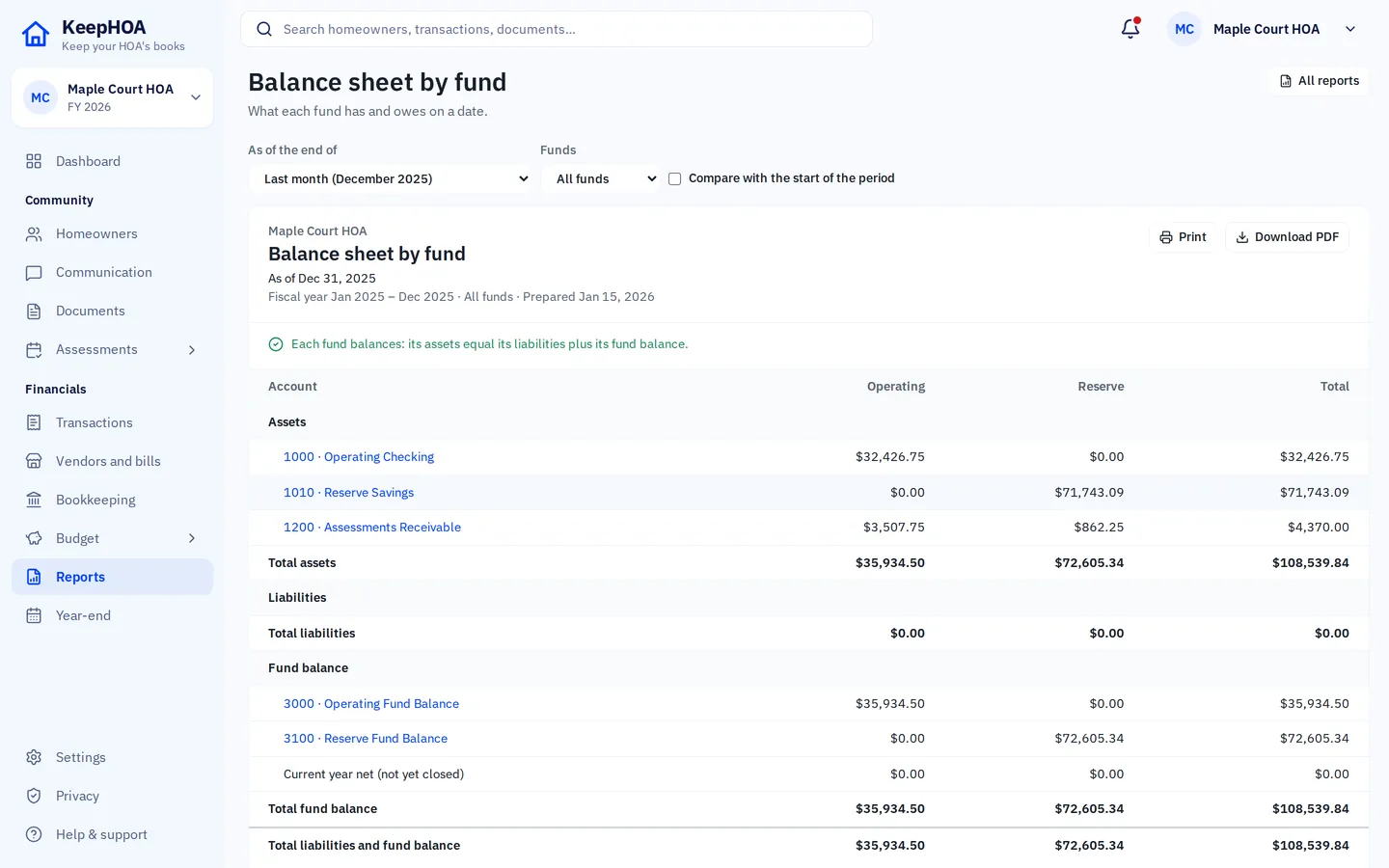
Operating and reserve: two funds, one list
The operating fund pays for this year: mowing, water, insurance. The reserve fund is money set aside for big, predictable replacements — roofs, paving, the pool surface. Owners and lenders look at the two separately, so the books have to keep them apart.
The tidy way to do that is one chart of accounts, with every entry tagged to a fund. Landscaping is one account, whichever fund pays for it. The reports then show each fund on its own. Moving money into the reserve is a transfer between funds (accounts 3900 and 3910 above), not an expense — otherwise the operating fund looks like it spent money it simply set aside.
Keep the expense list short
The board reads the budget line by line. Twelve clear expense accounts make a better meeting than forty tiny ones. If you need more detail, put it in the description of each payment rather than a new account.
General information, not accounting, legal or tax advice. Your accountant may prefer different account numbers for tax filing; the structure above maps easily onto theirs.
Questions
What is a chart of accounts for an HOA?
It’s the list of categories every dollar is recorded in: the bank accounts, what homeowners owe, what the association owes, the fund balances, and each kind of income and expense. Reports like the balance sheet and budget vs actual are totals of these accounts.
How should operating and reserve funds be set up?
Keep one list of accounts and record which fund each entry belongs to. That gives each fund its own balances without doubling every account. Reserve money usually sits in its own bank account, and moving money to the reserve is recorded as a transfer between the funds rather than as an expense.
Why are the accounts numbered?
Numbers keep the list in a sensible order — assets (1000s), liabilities (2000s), fund balances (3000s), income (4000s) and expenses (5000s and 6000s) — and leave room to add accounts later without renumbering.
Can I change the names or add accounts?
Yes. Download it as CSV or Excel and edit it. Try not to have too many expense accounts: the board reads the budget line by line, and fewer, clearer lines make better meetings.
Is this the chart KeepHOA uses?
Yes. The default list here is the one KeepHOA starts every association with; the questions only remove what you don’t need or add an amenities account.
Keep this in your HOA’s books
KeepHOA starts every association with this chart, already split into operating and reserve. Try it free for 30 days, then $149 once.